The Modern American Oligarchy
It’s not just in Russia anymore
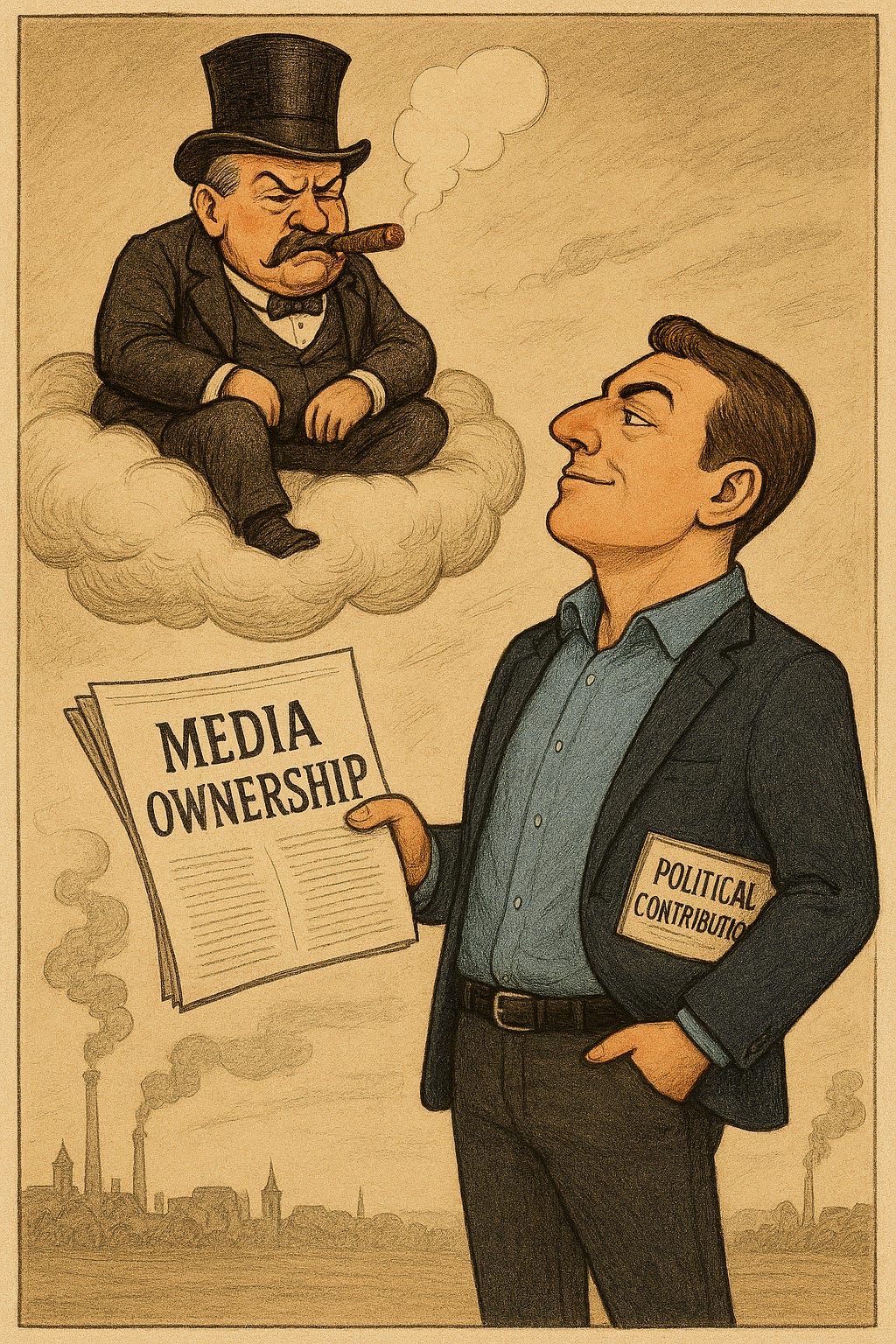
Oligarchs, in the modern context, are people who wield disproportionate economic and political power, mostly due to their immense wealth and close ties to those in authority. The term ‘oligarchy’ comes from the Greek words for ‘few’ and ‘rule’, and refers to a system in which a small group controls a country or organization. Oligarchs use their influence and resources to shape policy, influence government decisions, and maintain their privileged status, often at the expense of common citizens. In many ways, today’s oligarchs are similar to America’s 19th-century robber barons, who were known for their monopolistic practices and disregard for workers’ rights and welfare.
Today, when we think of oligarchs, we mainly think of Russia, where their rise can be traced to the turmoil following the Soviet Union’s collapse in 1991. As the old communist system imploded, Russia embarked on a rapid transition to a market economy, privatizing state-owned assets at an unprecedented speed. This process of ‘shock therapy’ was intended to foster competition and economic growth, but it actually allowed a handful of well-connected individuals to acquire vast fortunes by purchasing valuable industries, such as oil, gas, and metals, at fire-sale prices. They then used their wealth to manipulate the nascent political system, ensuring favorable laws and regulations, and often engaging in corruption, bribery, and even violence to protect their interests. This concentration of power undermined democratic institutions, limited economic competition, and caused widespread inequality and instability. Oligarchs became notorious for their ostentatious lifestyles, political meddling, and ability to operate above the law.
In recent decades, concerns have grown among a few—far too few--over the emergence of an American oligarchy. Those who cling to the belief that it can’t happen here are ignorant of history (to wit, the reference above to our robber barons of the 19th century). Not, mind you, that the danger of a return to the era of robber barons. Today’s American oligarchs are following a different playbook. American billionaires now routinely spend hundreds of millions of dollars to support political candidates, lobby for favorable policies, and shape public opinion through media ownership and philanthropy. This concentration of power and influence risks distorting the democratic process, as elected officials might become more responsive to wealthy donors than to ordinary citizens. Left unchecked, an American oligarchy can erode public trust, weaken institutions, and threaten the foundational principle of government by and for the people.
Examples of the impact of the rising American oligarchy have been many since the beginning of the second Trump administration in January 2025.
The world’s richest man, Elon Musk, whose net worth is approximately $230 billion, was the largest single donor to Trump’s reelection campaign, spending at least $277 million in support of Trump and other Republicans. After the inauguration, Musk was appointed co-leader (and effective controller) of the Department of Government Efficiency (DOGE), which took a wrecking ball and chainsaw to the executive branch, firing federal workers, cutting social programs, and slashing federal regulations. While DOGE’s stated mandate was to save money, its claims of savings have been exaggerated, and in some cases, its cuts have had to be reversed.
Another billionaire who has wielded outsized influence on Trump administration policy is PayPal founder and Tech mogul, Peter Thiel, whose net worth is approximately $8 billion. While he had no formal government position as Musk did, Thiel is associated with a number of organizations and individuals, including Vice President J.D. Vance and employees of his companies, who hold positions in the administration.
Just two of the mega-rich with chummy ties with the administration, Musk and Thiel, also benefit financially. The stock of Palantir, one of Thiel’s companies, has increased 90 percent in value since Trump’s election, and Anduril Industries, one of his defense-tech companies, landed a $20 billion contract from the government. Musk’s business empire, which includes Tesla and SpaceX, among others, was built on $38 billion in government funding, mostly contracts.
The impact of this rising American oligarchy is already being felt. A Pew Research study done in February 2025, less than a month into the administration, showed that a majority of US adults felt that corporations (70%) and wealthy people (65%) would gain influence in the new administration, while Hispanics (62%), the poor (56%), and Blacks (53%) would lose influence.
We’ve not gone the way of the Russian oligarchy, in that no one that we know has fallen from a window—yet—but it is clear that the wealthy are the main beneficiaries of the administration’s policies. Just as it is clear that we are very close to becoming an autocracy, we are equally close to having our very own class of oligarchs.